High-tech body contouring devices promise to improve your clients’ bodies, and your clinic’s bottom line, but which ones actually deliver?
The pursuit of the ‘body beautiful’ has never been greater.
Increasing numbers of men and women around Australia, and around the world, are spending increasing amounts of time and money to try and improve the shape they’re in.
Yes, despite the much-publicised demand for body-enhancing surgical procedures such as breast augmentations and Brazilian butt lifts, the majority simply want to lose weight, or more specifically, fat.
Fortunately, diet and exercise are no longer their only ‘treatment’ options.
Effective fat reduction treatments now also include surgery (eg, bariatric procedures such as lap-banding and gastric bypass as well as liposuction) and high-tech non-surgical body contouring treatments.
According to GrandView Research, the global market for such body contouring treatments was worth approximately US$5.9 billion last year and is expected to total US$6.3 billion this year before growing 7.7 percent per annum to reach US$9.3 billion by 2025.
The ‘experts’ are divided about the drivers behind this massive growth in demand.
Some attribute it solely to the obesity epidemic while others argue it is caused by the rise of social media (particularly Instagram ‘influencers’ and filters), the Kardashians (is there anything they’re not to ‘blame’ for?), changing beauty ideals, and figure-revealing fashion (including activewear).
Irrespective of the drivers, we can confidently predict that the market will continue to grow unless someone finally invents a ‘magic pill’ to melt our fat away (in all the right areas)!
This is good news for aesthetic clinics as, according to GrandView, the “non-invasive and minimally invasive segment” accounted for the largest share of the body contouring market in 2017 and “is expected to maintain its dominance” until at least 2025.
This is most likely because non-invasive and minimally invasive body contouring treatments are typically more affordable, more convenient, and less painful than their invasive counterparts. They can also be undertaken without the inherent risks and complications associated with surgery such as a lengthy recovery periods, scarring and infections – but still deliver visible results (albeit less dramatically).
So, what body contouring options are currently available for Australian aesthetic clinics?
There are too many device/treatment options to list as increasing numbers of tech companies vie for their share of the lucrative market, but most devices feature at least one of the following modalities:
Cryolipolysis (Fat Freezing)
Cryolipolysis treatments destroys fat cells by freezing them. The fat cells are gradually processed and eliminated from the body for up to 12 weeks afterwards. Cryolipolysis is ideal for stubborn pockets of fat such as double chins, love handles, inner thighs, ‘bra fat’ and upper arms. Results can sometimes be seen after just one treatment, but most clients require a “customised treatment plan”.
Radiofrequency Lipolysis
Body contouring devices using Radiofrequency (RF) use heat to destroy fat cells. After the treatment the fat cells are gradually processed and expelled from the body. Suitable for treating localised fat bulges as well as larger areas, Radiofrequency Lipolysis treatments are usually repeated once a week for four or five weeks.
Ultrasound (Fat Cavitation)
Fat cavitation devices use low-frequency ultrasound to destroy fat cells. The pressure of the ultrasound waves turns the fat cells into a liquid which is naturally processed and eliminated by the body gradually. Ideal for large areas of the body such as the stomach, flanks, thighs and buttocks, eight weekly treatments are required by most clients.
Laser Lipolysis
Best known for its use in skin rejuvenation and hair removal treatments, laser energy is also used to destroy fat cells. The laser’s heat liquefies the fat cells which are then processed and eliminated by the body. Recommended for small and large areas of fat, clients typically require six to eight treatments.
As you can see from the above, all the modalities aim to destroy fat cells as quickly and painlessly as possible without damaging any surrounding skin tissue.
The difficulty is choosing what modality is best for you and your clients as each has its pros and cons – and some brands have their own, often patented, modalities too.
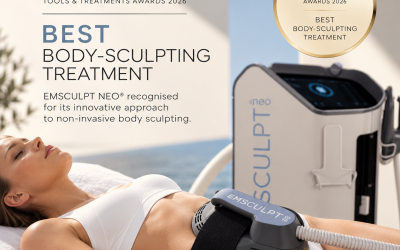
For example, BTL’s Emsculpt combines radiofrequency with ‘high-intensity focused electromagnetic energy while Venus Concept’s Bliss combines multi-polar radiofrequency and pulsed electromagnetic fields with VariPulse (adjustable pulsed suction) technology.
In addition, you might need more than one device/modality to cater for all your clients’ needs.
But there is no need to feel overwhelmed with the choices.
You only need to ask yourself one question: Can my clinic afford to miss out on its share of the US$6.3 billion dollar+ market.
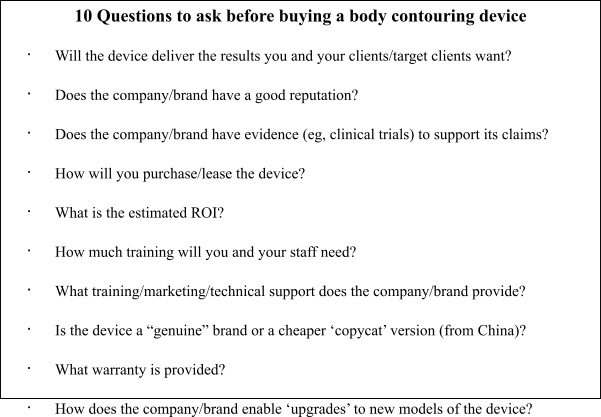
If your answer is ‘No’, do your research, contact two or three reputable suppliers, meet with them, evaluate your options, purchase ‘the right device’ and begin reshaping your clinic’s future – asap.
Body contouring treatments appeal to a far wider range of people than you probably realise – 70-something retirees often want to improve their bodies as much as 18-year-old models.
How many of your clients are really happy with their body?
We all know that people come in all shapes and sizes, but unfortunately, not all shapes and sizes are valued equally – and sadly, most are not 100 percent happy with their body.
And most, who aren’t happy with their bodies, want to lose weight (fat).
This is not surprising as the latest Australian Institute of Health and Welfare report revealed that roughly two out of three (67%) Australians aged 18 and over were overweight or obese’.
That’s around 12.5 million adults.
And many of the “one in three” who aren’t classified as overweight or obese, inevitably have a few pockets of fat they’d like to eradicate as they strive to meet their ‘body goals’
Indeed, a ‘hot bod’ is in many ways the new black, or the ultimate status symbol –
– social proof that the person is a ‘success’ as they have physical and mental discipline as well as the time and money to create and maintain their ‘temple’.
For these reasons and more, big brand chains and smaller independent clinics and spas in cities and regions around the country are moving into the body contouring market.
The good news is that the ‘pie’ (which we are all clearly overeating) is big enough for everybody.
And even better, many, although obviously not all, the treatment options available today do deliver the results they promise so your clinic can help your clients reach their body goals – or at least feel a little bit less conscious on the beach this summer.
* This article is intended as a guide only. Please consult the manufacturer/distributor before purchasing/using a body contouring device.
BOX OUT